
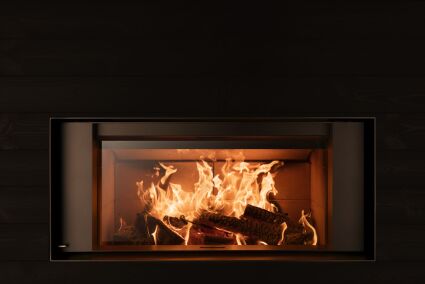
A wood-burning insert heats your home far more efficiently than an open fireplace. While an open fire typically delivers around 10–15% efficiency, a modern insert can reach 75–80% or more. The difference comes down to heat retention, combustion control and air circulation.
If your goal is to heat your home effectively with wood, a closed fireplace insert is the best solution. It captures heat, controls combustion and distributes warmth throughout the room.
In an open fireplace, most of the heat generated by burning wood goes straight up the chimney. This results in significant energy loss and low heating performance.
An open fireplace constantly pulls warm air from the room and sends it outside. This creates a negative pressure effect, cooling your home even when the fire is not burning.
Without precise airflow control, combustion remains incomplete. This leads to lower temperatures, higher emissions and inefficient use of fuel.
A Stûv wood insert features a sealed combustion chamber. This allows precise control of oxygen intake, ensuring optimal combustion conditions.
With efficiencies reaching 75–80% or more, inserts convert most of the wood’s energy into usable heat.
Unlike open fireplaces that rely mainly on radiation, inserts use convection to distribute warm air evenly throughout the room.
Because of improved efficiency, you need significantly less wood to achieve the same level of comfort.
A wood insert provides stable and consistent heat. It avoids temperature fluctuations and improves indoor comfort, especially during colder periods.
Modern inserts like those from Stûv are designed to reduce emissions significantly. More complete combustion means fewer particles and better air quality.
Yes. Replacing an open fireplace with a wood insert improves heating efficiency, reduces fuel consumption and increases comfort. It is one of the most effective upgrades for wood heating.
If you want to heat your home efficiently with wood, a Stûv insert is the clear choice. It combines performance, comfort and energy efficiency in a single solution.