
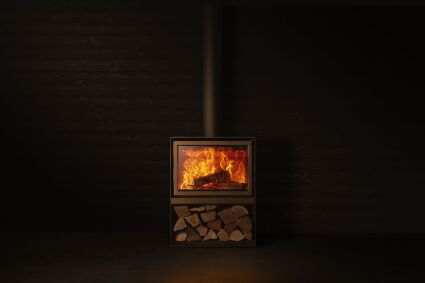
Many people describe a wood-burning stove as a "supplementary" or "backup" heating solution. That framing undersells what a well-designed stove can do. A properly sized wood-burning stove heats your living space throughout the shoulder seasons — autumn and spring — without calling on the central heating system. The boiler only takes over when outdoor temperatures drop below freezing. That is not supplementary heating. It is a heating strategy. Here is what the 2025-2026 figures show.
In the UK, the comparison is more nuanced than in continental Europe. When buying kiln-dried hardwood logs in bulk, the cost per kWh drops to around 6-8p — broadly comparable to mains gas at around 7p per kWh.
At first glance, this suggests wood offers no clear cost advantage over gas. That reading misses a crucial point: central heating warms every room in the house, including those no one is using. A wood-burning stove heats the specific living space you are occupying — you are not comparing like-for-like. You are comparing heating a whole house against heating a single room.
This distinction changes the economics entirely. If you spend your winter evenings in one room, you can turn your central heating thermostat down significantly and let the stove carry the load. According to the Energy Saving Trust, turning your thermostat down by just one degree Celsius saves around £80 a year. A reduction of five or six degrees — perfectly comfortable with a log burner running — translates to around £400-500 in annual savings.
Against electricity, the advantage of wood is unambiguous. Kiln-dried logs can cost as little as 3.3-7.6p per kWh when burned efficiently in a modern Ecodesign stove — substantially cheaper than electricity, and often competitive with gas.
A typical Ecodesign wood-burning stove running during evenings and weekends across the heating season — mid-October to mid-April — uses approximately 3 to 3.5 cubic metres of kiln-dried hardwood logs. At current bulk prices of £160-230 per cubic metre, that represents a seasonal fuel cost of between £560 and £770.
That is the cost of heating your main living space for six months. Your gas central heating bill for the same period, on the other hand, will typically be the larger part of your annual energy spend.
The real saving is not found by switching entirely to wood — most homes in the UK cannot do that with a standalone stove. It is found by using the stove strategically: heat the room you are in, reduce the whole-house thermostat, and let the boiler do less work.
A traditional open fireplace rarely exceeds 10-15% efficiency — the vast majority of the heat produced by combustion escapes up the chimney. An older stove may reach 50-65%. Modern Ecodesign-compliant stoves achieve over 80% efficiency.
Stûv wood-burning stoves are tested and certified to the EN 16510 standard, in force since November 2025. Their efficiency exceeds 80%, which means far more of the energy contained in each log is converted to useful heat rather than lost as exhaust.
This gap matters when calculating fuel costs. A log that produces 3kWh of useful heat in an 80% efficient stove would produce less than 0.5kWh in a traditional open fire. The combustible is the same — the appliance changes everything.
Stûv stoves are built to maintain this performance over time. Their interiors withstand temperatures above 700°C without deformation, and spare parts are guaranteed available for ten years.
UK energy bills have risen by at least 80% since 2022. Gas prices remain subject to geopolitical pressures and global market movements. Firewood, particularly sourced locally, follows a different logic — regional supply and demand, rather than international commodity markets.
That predictability has real value. A household that supplements gas with wood is partially insulating itself from the price volatility that has characterised energy markets since 2021.
is used strategically rather than as a full replacement for central heating. The savings come primarily from reducing gas consumption during the evenings when you are heating a single room. Installation costs of £1,500-3,500 are recouped over time, typically within five to ten years depending on usage.
What is the cheapest way to run a log burner? Buy seasoned or kiln-dried hardwood in bulk at the start of the season — bulk bags of approximately one cubic metre typically offer the lowest cost per kWh. Avoid small retail bags of logs, which can cost two to three times more per kWh. Always burn wood with a moisture content below 20%.
Does a wood-burning stove have to comply with UK regulations? Yes. In England, Wales and Scotland, any wood burned in a stove must be certified Ready to Burn or have a moisture content below 20%. New appliances sold after November 2025 must comply with the European EN 16510 standard. Some areas — particularly Smoke Control Zones in cities — impose additional restrictions. Your authorised Stûv dealer can advise on local requirements.
How often must a chimney connected to a wood-burning stove be swept? At least once a year, and ideally twice for regular users. This is both a legal requirement under UK building regulations and an insurance condition for many household policies. Use a qualified sweep registered with the Guild of Master Chimney Sweeps or the National Association of Chimney Sweeps.
than electricity. The financial case for a log burner rests less on the price of the fuel itself and more on the logic of targeted heating: heat the room you are in, reduce whole-house energy consumption, and achieve significant savings through lower thermostat settings. A high-efficiency Stûv stove amplifies these savings by extracting maximum heat from every log.
The economics depend on your home, your heating habits and your access to competitively priced firewood. Your local Stûv dealer can help you assess the potential savings for your specific situation.
Note on sources: UK fuel price data from Checkatrade, Direct Stoves and The Log People (2025-2026). UK energy tariff data from Ofgem price cap (2025). Savings estimates from the Energy Saving Trust.